
How to Create Platonic Geometric Solids (Polyhedra Nets)
Foldable 3D Icosahedron, Dodecahedron & Octahedron Polyhedra
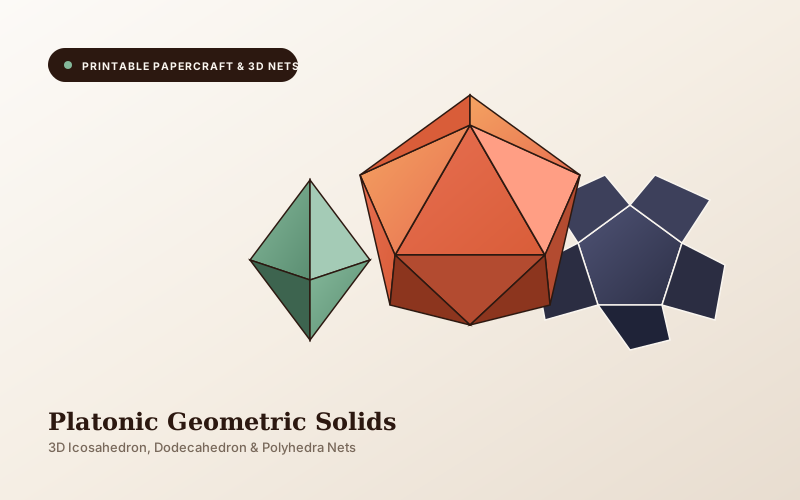
What You Need Before Starting
Folding Instructions (5 Steps)
Follow each step in order. Press your folds firmly against the table using your thumbnail or a ruler for maximum performance.
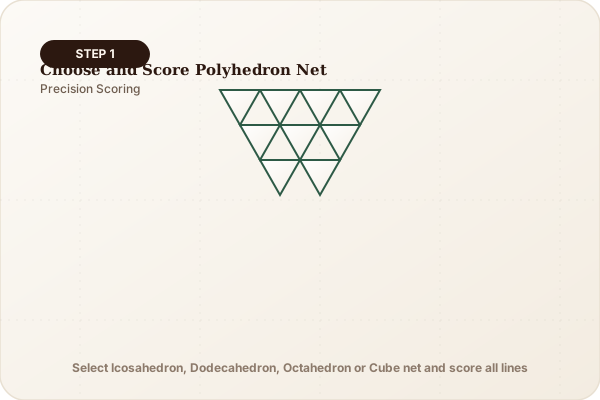
Choose and Score Your Polyhedron Net
Select a Platonic solid net: Octahedron (8 triangles), Dodecahedron (12 pentagons), or Icosahedron (20 triangles). Score all internal fold lines with a ruler.
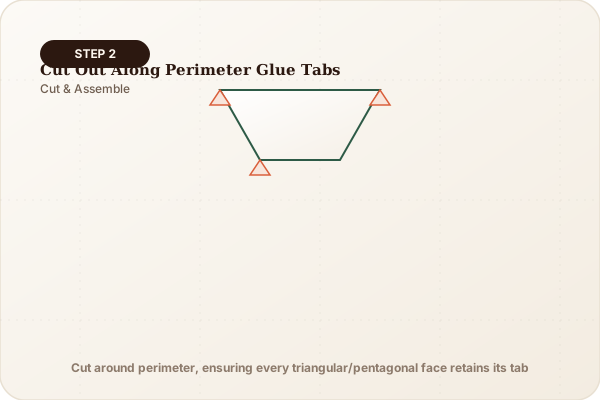
Cut Out Along the Perimeter Glue Tabs
Cut along the solid outer perimeter lines, being careful to preserve every trapezoidal glue tab attached to the outer polygon edges.
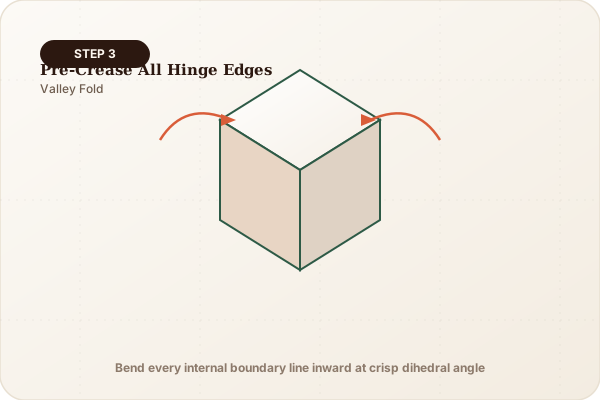
Pre-Crease All Hinge Edges
Fold every scored hinge line and glue tab inward (Mountain Folds) to prepare the paper to naturally curve into a 3D sphere-like polyhedron.
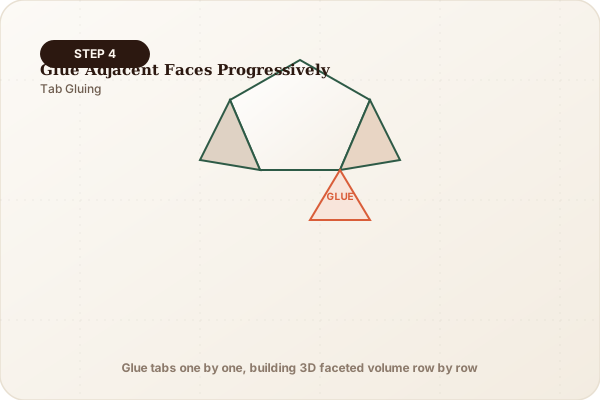
Glue Adjacent Faces Progressively
Apply small dabs of glue to the tabs and join adjacent faces one by one, watching the flat net wrap around into a 3D geometric dome.
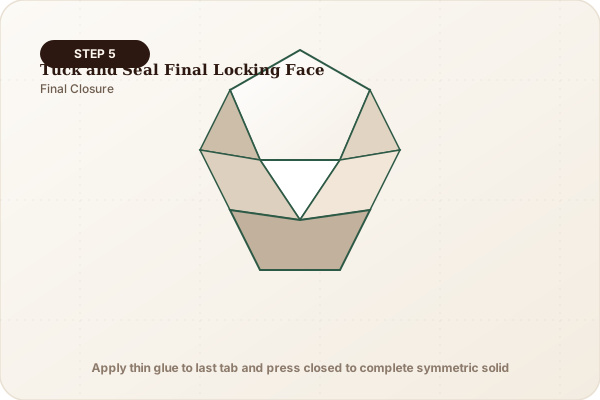
Tuck and Seal the Final Locking Face
Apply glue to the final closing tab, tuck the last polygon lid into position, and press firmly against the edges to seal your finished Platonic solid!
Platonic Polyhedra Symmetry & Euler’s Polyhedral Formula
In three-dimensional Euclidean space, there are only 5 regular convex polyhedra (Platonic solids) where every face is an identical regular polygon meeting at identical vertices. Swiss mathematician Leonhard Euler proved that for all convex polyhedra, the number of Vertices minus Edges plus Faces always equals exactly 2!
The 20-sided Icosahedron (20 triangular faces) is the geometric shape used in real geodesic domes and viral capsid shells.
Skills Your Child Develops with This Craft
Spatial Geometry & Euler Formula Understanding
Physically counting vertices, edges, and faces to prove mathematical formulas tangibly.
Regular Polygon Symmetry Appreciation
Experiencing how equilateral triangles, squares, and regular pentagons assemble into closed 3D solids.
Precision Tab Scoring and Seaming
Aligning multi-facet glue tabs with clean edge-to-edge accuracy.
Fun Family Mini-Games to Play
Euler’s Polyhedral Verification Challenge
Count the Vertices (corners), Edges (lines), and Faces (sides) of your completed shape. Calculate V - E + F to verify it equals exactly 2!
Geometric Hanging Tree Ornament
Thread a metallic loop through one vertex before closing the final tab to transform your polyhedra into stunning geometric room ornaments.
Parent Note:
Handling physical 3D geometric solids builds spatial math intuition that 2D textbook drawings can never replicate.
More Projects in Printable Papercraft & 3D Net Models & Beyond
How to Create Low-Poly 3D Papercraft Animals
Transform flat 2D geometric polygonal nets into striking modern 3D low-poly faceted paper animal sculptures for desk display.
How to Create a Historical Architecture Pop-Up
Engineer an architectural 3D pop-up card featuring the Roman Colosseum and classical arches that lies completely flat when closed and springs into towering 3D when opened.
How to Create a Hanging Solar System Mobile
Fold 3D planetary paper spheres and assemble a balanced kinetic hanging mobile featuring the Sun, Earth, Saturn, and Jupiter orbiting your ceiling.