
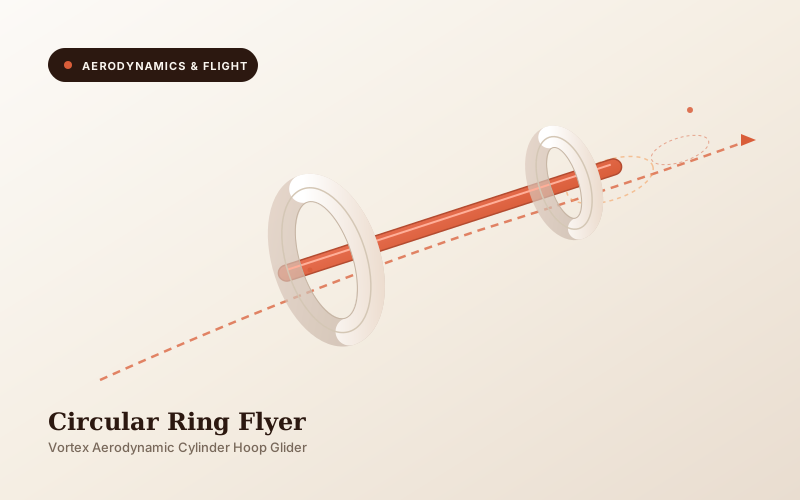
How to Create a Circular Ring Flyer (Hoop Glider)
Vortex Aerodynamic Cylinder Glider that Defies Expectations
What You Need Before Starting
Folding Instructions (5 Steps)
Follow each step in order. Press your folds firmly against the table using your thumbnail or a ruler for maximum performance.
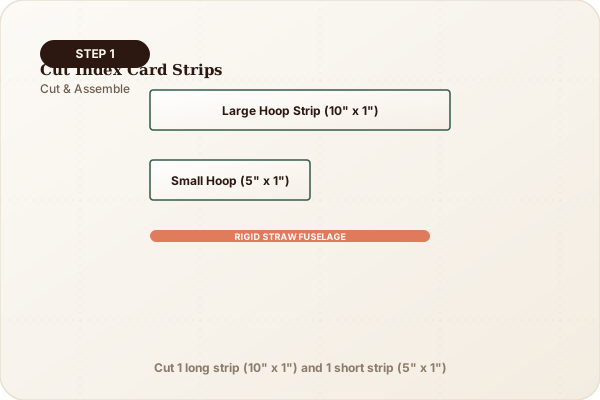
Cut the Two Paper Strips
Cut two strips from cardstock or heavy paper: one 1 inch wide by 10 inches long, and a second 1 inch wide by 7 inches long.
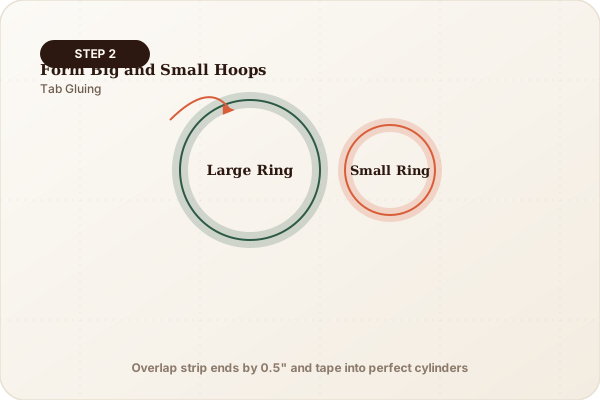
Tape Strips into Circular Hoops
Curve each strip into a circle, overlapping the ends by half an inch, and secure with a piece of clear tape inside and outside. You now have one large hoop and one smaller hoop.
Attach the Small Front Hoop
Place one end of the drinking straw on the inside bottom of the small hoop. Tape the straw firmly in place aligned straight along the straw’s axis.
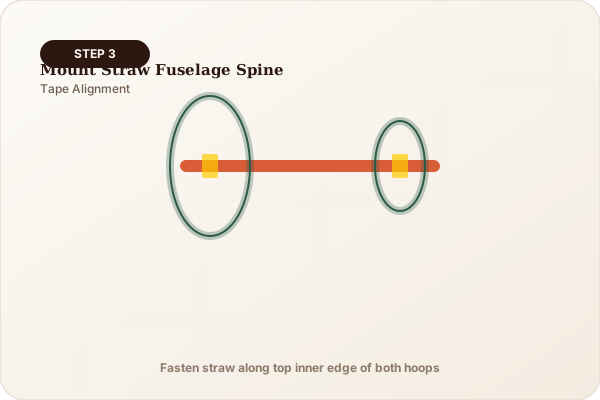
Attach the Large Rear Hoop
Tape the large hoop to the other end of the straw in the exact same orientation so both hoops line up centered with each other like a telescope.
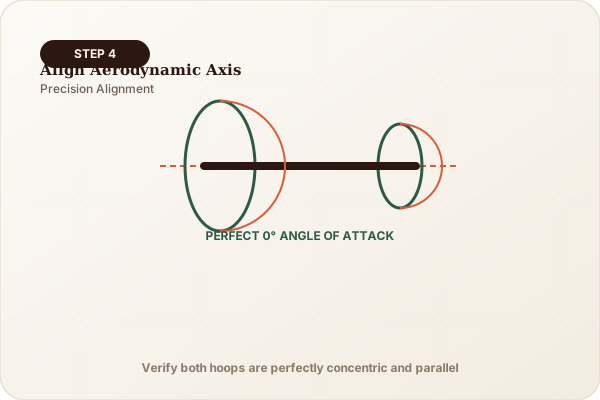
Launch with Small Hoop Forward
Hold the glider by the middle of the straw with the smaller hoop facing forward. Throw it gently level with the floor like a spear.
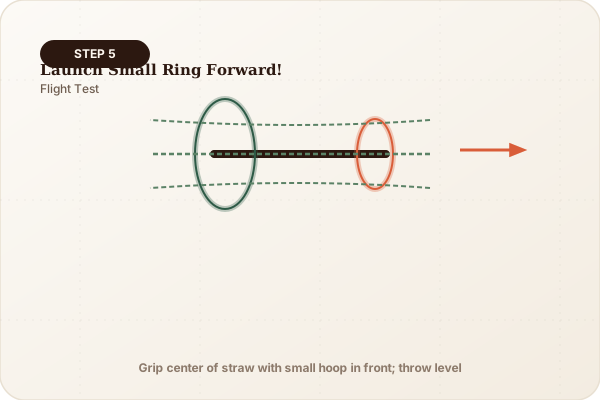
Vortex Aerodynamics & Tubular Airfoil Lift
Though it has no flat wings, the curved cylindrical hoops act as tubular airfoils. Air rushing through and around the circular hoops creates toroidal vortex lift. The smaller front loop breaks initial air resistance and stabilizes the pitch while the larger rear loop provides sustained gliding lift.
The circular shape prevents wing-tip air spill vortices, allowing hoop gliders to travel exceptionally straight and far with minimal effort.
Skills Your Child Develops with This Craft
Unconventional Design Thinking
Challenging assumptions about what an airplane "must" look like sparks creative problem solving.
Proportional Measurement
Measuring and comparing strip lengths (10" vs 7") reinforces spatial ratios and linear sizing.
Aerodynamic Center-of-Mass Alignment
Understanding why the smaller hoop MUST go in front for stable forward momentum.
Fun Family Mini-Games to Play
Long-Distance Hallway Fly-Off
Compare the flight distance of your Ring Flyer versus a standard paper airplane. Ring flyers often win by 10+ feet!
Straw Length Experiment
Test a 6-inch straw vs a 9-inch straw to discover how fuselage length influences pitch stability.
Parent Note:
Children are universally astonished the first time they see a ring glider fly. It is a fantastic gateway into teaching that lift is about air pressure differentials, not just flat wings.
More Projects in Aerodynamics & Flight & Beyond
How to Create High-Flyer Paper Aero Planes
Master the timeless craft of folding precision aerodynamic paper airplanes that glide smoothly across rooms and teach essential physics of lift.
How to Create an Aerobatic Stunt Plane
Fold a high-speed aerobatic paper jet featuring wide delta wings and precision rear elevons capable of executing barrel rolls, loops, and return swoops.
How to Create an Auto-Rotating Paper Helicopter (Whirligig)
Construct a simple dual-blade paper helicopter that spins automatically as it descends through air, teaching rotor aerodynamics and terminal velocity.