
Ancient 7-Piece Geometric Tangram Challenge Set
Spatial Dissection, Geometric Equivalence & Convex Polygons

What You Need Before Starting
Assembly & Setup Instructions (5 Steps)
Follow each step in sequence. Encourage your child to participate in measuring, cutting, calibrating, and testing each mechanical and sensorial feature.
Draw the Precision 7-Piece Dissection Geometry
On a 15cm x 15cm square, draw the diagonal. Follow standard tangram geometric dissection lines to mark: 2 Large Triangles, 1 Medium Triangle, 2 Small Triangles, 1 Square, and 1 Parallelogram.
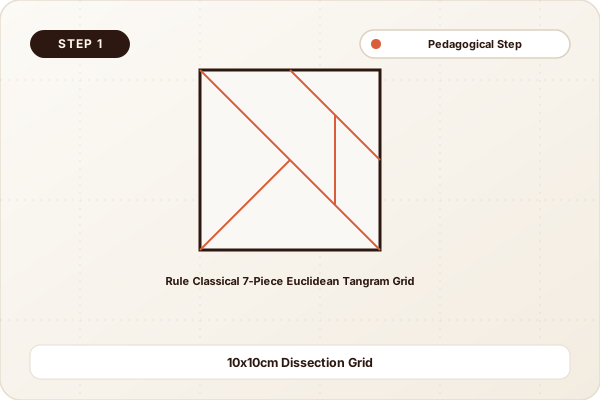
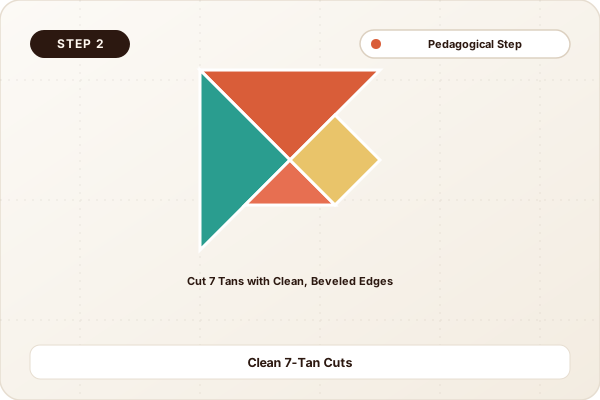
Cut the 7 "Tans" with Clean Edges
Cut along the marked lines with scissors or a hobby knife. Keep edges straight and corners sharp so pieces fit flush against one another.
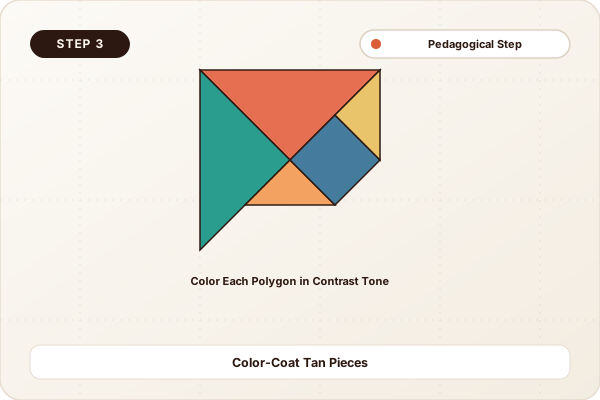
Paint Each Polygon in Distinct Harmonious Colors
Paint each piece in vibrant contrasting colors (terracotta, teal, sunny yellow, sage green, cream, espresso, coral) or leave in natural wood tones.
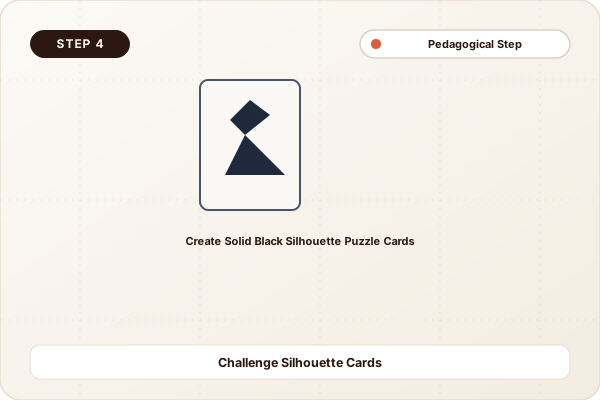
Draw Black Silhouette Challenge Cards
Draw solid black silhouettes of famous tangram puzzles (running person, swan, candle, sailboat, cat, arrow) on index cards, with the solution map on the back.
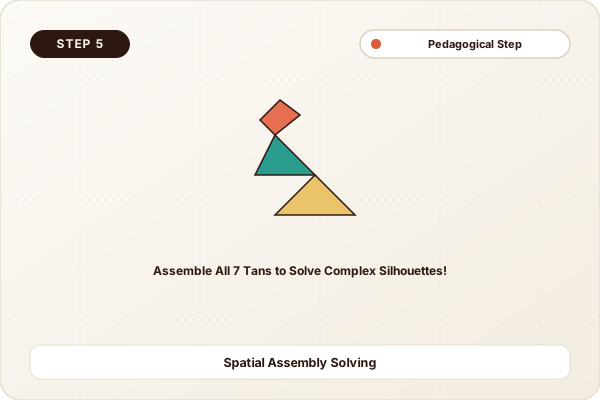
Solve Puzzles Using All 7 Tans
Select a silhouette card. Arrange all 7 pieces flat without overlapping any edges to match the silhouette outline perfectly.
Geometric Conservation of Area & Transformations
A tangram dissects a master square into 7 geometric polygons (2 large triangles, 1 medium triangle, 2 small triangles, 1 square, 1 parallelogram). Total surface area is strictly conserved across hundreds of reconfigurable shapes.
Rotating and reflecting the same 7 pieces can construct thousands of distinct animal, human, and convex geometric silhouettes.
Cognitive Milestones & Skills Developed
Spatial Rotation & Mental Imagery
Mentally rotating polygons to match negative space in silhouette puzzles.
Geometric Decomposition
Recognizing that two small triangles combine into a square, parallelogram, or larger triangle.
Focus & Visual-Spatial Tenacity
Solving complex spatial problems without giving up when shapes do not fit on first try.
Fun Family Explorations & Logic Games
The 13 Convex Polygon Challenge
Mathematicians proved only 13 distinct convex polygons can be formed using all 7 tangram pieces. Try discovering at least 4 of them (square, triangle, rectangle, trapezoid).
Storybook Creation Challenge
Assemble 5 different animal tangrams in sequence and write an illustrated adventure story about their journey.
Parent & Educator Note:
Invented during China’s Song Dynasty and popularized globally in the 1800s, tangrams remain one of the most powerful spatial geometry tools ever created.
More Projects in Math & Spatial Tactile Toys & Beyond
Segmented Tactile Fraction Strips & Equivalence Circles
Build a multi-color tactile fraction tile set and circular fraction pie kit from upcycled cardboard to turn abstract fractions (1/2, 1/3, 1/4, 1/6, 1/8) into concrete visual manipulatives.
Equal-Arm Arithmetic Number-Weight Equation Balance
Build an equal-arm math balance scale using a clothes hanger or wooden ruler, calibrated peg notches (1 to 10), and washer weights to balance mathematical equations visually.
Escher-Style Interlocking Geometric Tessellation Tiles
Design and assemble interlocking M.C. Escher-style geometric tiling pattern blocks from craft foam or cardboard that fit together endlessly with zero gaps or overlaps.