
Recycled Container String Telephone: Acoustic Vibration & Mechanical Sound Transmission
Transmit Secret Analog Audio Waves Across Rooms by Turning Clean Food Containers and Taut Twine into a Phone
- Ensure all container rims are completely smooth. If using metal cans, wrap multiple layers of thick duct tape over the rim to eliminate all sharp edges.
- Adult supervision is required when puncturing center holes using pins or nails.
- Never wrap long string around necks or body parts; supervise young children during play.
Everything You Need to Build This Toy
- 2 clean recycled food containers (paper takeout cups, yogurt pots, or plastic beverage cups)
- 2 metal paper clips or wooden toothpick halves (anchor stops)
- 6 to 10 meters of non-elastic cotton baker’s twine or kite string
- Masking tape or colored washi tape (edge safety and decoration)
- Markers or stickers for personalizing transceiver cans
- Pushpin, thumbtack, or small nail (adult assistance for puncture)
- Child-safe safety scissors
- Ruler or measuring tape
Assembly Instructions (5 Steps)
Follow each step carefully. Work together to clean waste, score precise cuts, align pivots, and test kinetic mechanics.
Prep & Smooth Recycled Container Rims
Thoroughly wash and dry two recycled containers (paper coffee cups, yogurt tubs, or clean tins). Inspect the open rims carefully. Wrap a strip of smooth masking tape or fabric tape around the top perimeter of each container to ensure total comfort against ears and lips.
Inspects and cleans the cups, then wraps colorful protective tape around the top open rim.
Safety first: taping ensures children can press their ears and lips snugly against the rim without irritation.
Two pristine, smooth-rimmed cups decorated and ready for acoustic conversion.
Using containers with cracked plastic or sharp metal burrs. Always discard damaged cans.

Puncture Centered Diaphragm Pilot Hole
Turn each cup upside down. Using a pushpin or small nail with adult guidance, pierce a tiny hole dead center in the bottom base of each cup. The hole should be just wide enough for your twine to thread through snugly.
Marks the exact center of the cup base with a dot and assists an adult in pushing the pin through.
Centering the hole ensures symmetric tension across the circular diaphragm, maximizing acoustic resonance.
A clean, tiny puncture hole in the exact geometric center of each cup base.
Making the hole too large, which allows the string to wobble loose and impairs vibration transfer.

Thread String & Lock with Paperclip Stop
Push one end of your 6-to-10 meter string through the outside of the cup base into the inside. Tie the string securely around a metal paperclip or toothpick half, then pull the string back from the outside so the paperclip sits flat against the inside bottom.
Threads the string into the cup and helps tie it around the paperclip anchor.
A paperclip distributes pulling force across a wide area of the cup bottom, preventing the string from ripping through.
Both cups are now linked by a long strand of twine, securely anchored inside each base.
Tying a simple knot without a paperclip; under tension, small knots easily tear through paper bases.

Stretch Cord Completely Taut Across Distance
Hold one cup while a partner takes the other cup and walks across the room or down the hallway until the string is completely straight, level, and pulled guitar-string taut. The string must not touch any walls, furniture, or fingers.
Steps backward slowly until feeling firm resistance from the partner, keeping the line suspended in air.
Tension is essential: loose strings absorb wave energy through slack flex, while taut strings transmit vibrations instantaneously.
An arrow-straight line suspended in mid-air connecting two eager communicators.
Allowing the string to rest over the back of a chair or rub against a hallway corner.

Speak, Listen & Touch Cord to Feel Vibrations
One person speaks in a soft whisper directly into their cup, while the other person presses their cup firmly against their ear. Next, have the listener gently touch the taut string with two fingertips while the speaker is talking to feel the physical buzz!
Whispers secret messages, listens intently to incoming audio, and touches the string to feel the physical vibrations.
Feeling the vibrations with fingertips proves that sound is a tangible mechanical movement of matter.
A secret conversation where quiet whispers sound startlingly loud, crisp, and clear inside the receiver cup.
Covering the cup opening with your cheek or hand, blocking the sound waves from reaching the diaphragm.

Acoustic Vibrations, Wave Propagation & Mechanical Solid Coupling
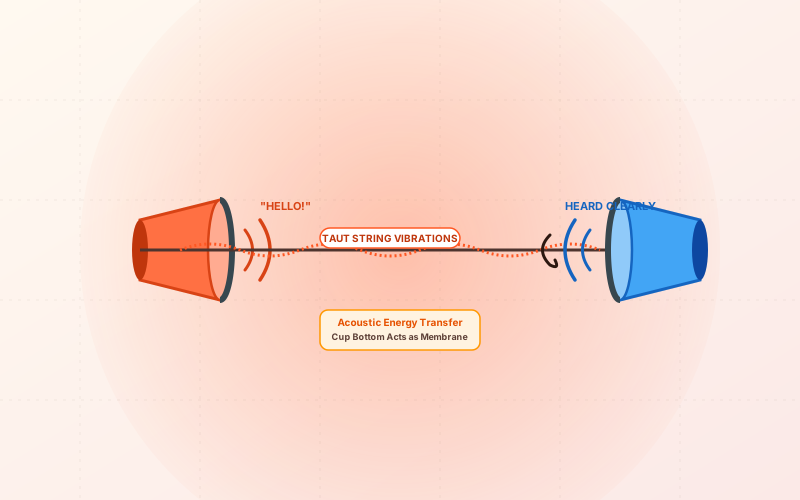
Sound is not an intangible entity; it is a physical mechanical pressure wave caused by vibrating molecules. When you speak into the transmitter cup, your vocal cords vibrate the air inside your throat, which in turn vibrates the air column inside the cup. These sound waves strike the bottom of the container, which acts as a flexible acoustic diaphragm. Because the string is pulled taut and locked to the center of the diaphragm, the vibrating cup base pushes and pulls on the string, launching longitudinal compression waves through the tightly tensioned solid fibers. Sound travels roughly 343 m/s through air, but through dense, tensioned solid string it travels nearly ten times faster and with far less geometric dispersion. When the waves reach the receiver cup, the vibrations shake the second diaphragm, which vibrates the air in the cup and transmits the audible whisper directly into your friend’s ear.
Sound waves vibrate the cup diaphragm, which sends mechanical waves through tightly tensioned string into the listening cup diaphragm without using any batteries.
Skills Your Child Develops with This Project
Auditory Sensitivity & Communication
Practicing turn-taking conversation, active listening, and modulating vocal volume from whispers to normal speech.
Intuitive Physics of Waves & Tension
Experiencing how mechanical tension and material damping directly control the transmission of acoustic energy.
Cooperative Social Play
Working in tandem with a sibling or parent to hold distance, maintain line tension, and synchronize communication.
Fun Family Experiments & Mini-Games
The Secret Code Whisper Relay
Whisper a 5-word secret password at the quietest possible volume. Can your partner repeat the exact words back to you correctly?
The Vibration Dampening Test
While your partner is speaking continuously, pinch the middle of the string with your thumb and forefinger. What happens to their voice instantly?
Change One Variable & Observe What Happens
True scientists don’t just follow instructions—they test hypotheses! Try these guided experiments to see how altering physical variables changes your toy’s behavior.
Slack vs. Taut Line Transmission
Whisper while the string is pulled arrow-taut. Then take two steps forward so the string sags into a gentle curve. Can you still hear the whisper?
Line tension / String sag
Expected Observation:A taut line transmits clear audio; a sagging slack line absorbs the mechanical waves, causing total silence.
Transceiver Cup Material Face-Off
Build three pairs of telephones using: (A) paper coffee cups, (B) thin plastic yogurt tubs, and (C) clean metal soup cans with taped rims. Which material sounds loudest and crispest?
Diaphragm material (paper vs. plastic vs. metal)
Expected Observation:Thin metal and stiff paper diaphragms have higher acoustic resonance and deliver clearer treble frequencies than soft, flexible plastic tubs.
The Three-Way Conference Call
Tie a third piece of string to the exact center of the main line, and connect a third cup. Can three people talk and listen simultaneously?
Network junction / Wave splitting
Expected Observation:Sound waves split at the T-junction and travel down both branches, creating a working multi-party phone line.
3 Discussion Questions for Parents & Teachers
What happens to the whisper when you pinch or grab the middle of the string while your friend is talking?
Can you feel a tiny buzzing tickle on your fingertips when you gently touch the string while someone speaks?
Why does sound travel so much better through a tight string than through open room air?
Troubleshooting & Quick Fixes
The string is slack, drooping, or touching a table edge, wall, or clothing.
Step apart until the line is guitar-string taut and completely clear of any physical obstacles.
The hole was punched too large, or no anchor paperclip was used.
Tie the string securely around a paperclip or toothpick inside the cup to distribute tension across the base.
The speaker is whispering away from the cup, or their hand is covering the base.
Hold the cup rim 1-2 cm from your mouth and speak directly at the bottom diaphragm while keeping fingers on the side walls only.
Make It Your Own: Safe Design & Decorative Ideas
Why Reusing This Waste Matters
Single-use coffee cups and takeout beverage containers are discarded by the tens of billions globally every year. Many have thin waterproof linings that make them difficult to recycle in standard paper mills.
Diverting clean food containers into acoustic science instruments demonstrates how simple packaging items possess valuable resonant properties before being thrown away.
Parent Note:
An iconic childhood science project that provides instant, delightful proof of physical sound waves and mechanical acoustics through collaborative two-person play.
DIY string telephone
/toys/trash-eco-toys/recycled-string-telephone
Beginner • 4-9 Years
20 Minutes
Make a classic string telephone from recycled cups and twine! Discover acoustic vibrations, tension, and sound wave transmission with ToyToBook.
AI Photography & Diagram Prompts (Hero, Materials, Step-by-Step)▼
Warm, charming DIY craft photograph of two smiling young children across a bright living room using a string telephone made from colorful decorated paper cups. A taut red baker’s twine stretches straight between them in mid-air. Soft natural window light, joyful expression, clean uncluttered space, no text.
Top-down knolling craft layout showing two clean paper cups with taped decorative rims, a ball of cotton twine, two metal paperclips, a pushpin, colorful washi tape rolls, and child scissors on a light wooden table.
Close-up instructional photograph showing a child’s hand inserting a piece of twine through the pre-punched bottom of a paper cup and tying it around a silver paperclip to form a secure internal anchor stop.
More Upcycled Projects in Bottles, Caps & Straws & Beyond
Recycled Bottle Balloon-Powered Jet Racer
Build a jet-propelled racer car from an empty plastic water bottle, straw axles, and bottle-cap wheels powered by escaping balloon air.
DIY Cartesian Diver in a Sealed Bottle
Build the classic Cartesian Diver using a plastic bottle, water, and an eyedropper or pen cap weighted with paper clips that dives and ascends on command.
DIY Musical Straw Pan Flute & Pitch Harmonizer
Construct a 8-note diatonic musical pan flute using upcycled drinking straws trimmed to calculated lengths to play real melodies and understand acoustic frequency.